You install a beautiful rain shower and the water comes out as a weak drizzle. It is one of the most common disappointments in Indian bathrooms, and a rain shower pressure problem is usually not the shower's fault. It comes from how water reaches your bathroom. This guide explains why, how to check your own home in ten minutes, and what to do about it before you buy.

Why pressure is often low in Indian homes
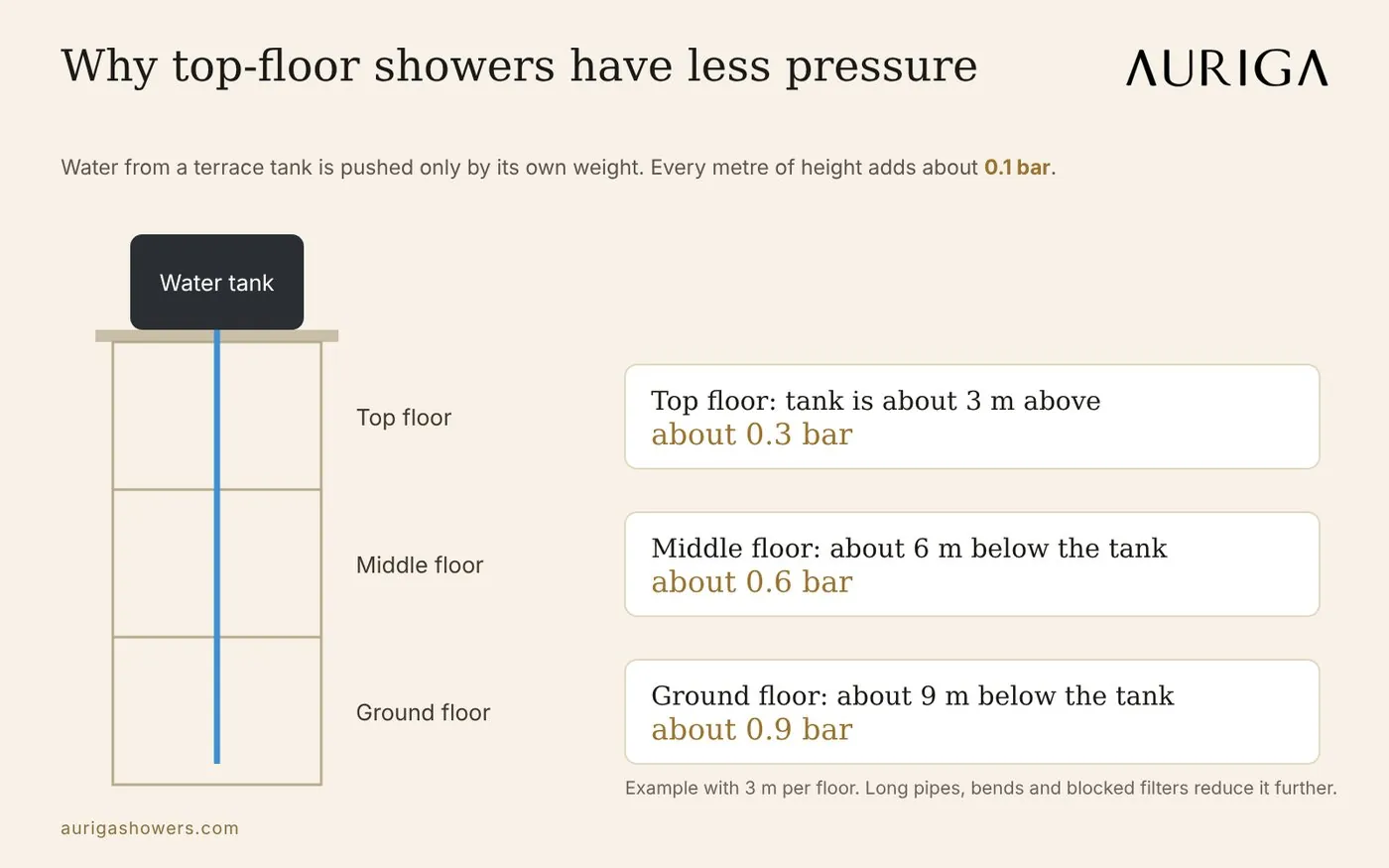
Most homes here are fed from a tank on the terrace. The water is pushed only by its own weight, and the height of the tank above your bathroom decides the pressure. Each metre of height gives about 0.1 bar. A tank 3 metres above your shower gives roughly 0.3 bar. That is why a top-floor bathroom, closest to the tank, usually has the weakest water, and a ground-floor bathroom the strongest.
Pipes make it worse. Long runs, many bends, narrow or old pipes, and blocked filters each take away some pressure before the water reaches the shower.
Pressure and flow are not the same thing
Pressure is the push behind the water. Flow is how much water arrives each minute. A rain shower spreads water over many nozzles, so it needs enough flow to keep every nozzle working, and enough pressure to push it through. A large head with hundreds of nozzles will feel gentle on a weak supply. A smaller head can feel stronger on the same supply.
Check your own home in ten minutes
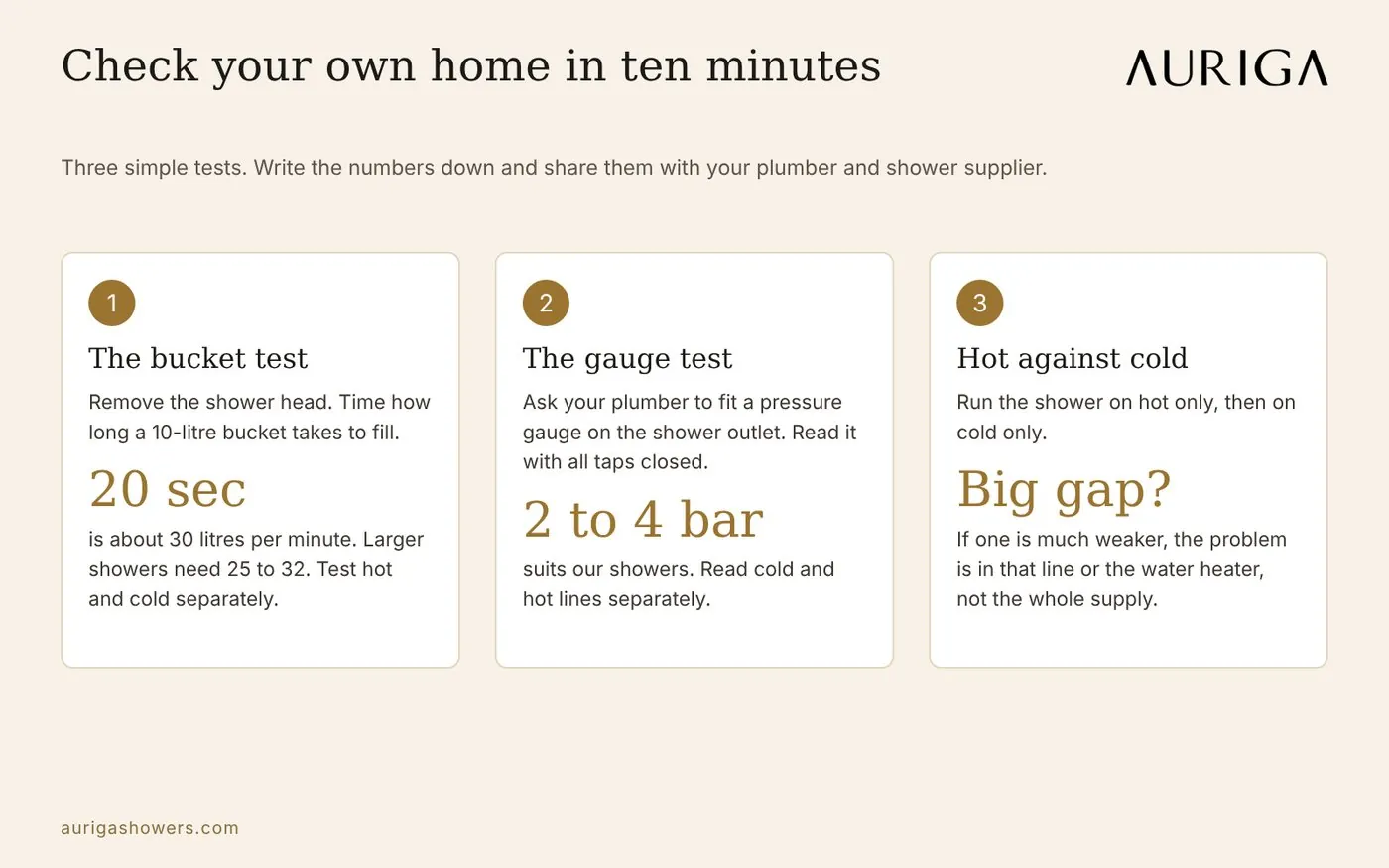
- The bucket test (flow). Take the shower head off, or use the open pipe at the bathroom. Time how long it takes to fill a 10-litre bucket. Note the seconds. Ten litres in 20 seconds is about 30 litres per minute, which is inside the 25 to 32 litres per minute our larger showers need. Do the test on the cold line and the hot line separately.
- The gauge test (pressure). Ask your plumber to fit a simple pressure gauge on the bathroom's shower outlet. It is inexpensive and takes a few minutes. Read it with all taps closed (static pressure), on the cold line and the hot line separately. Note both readings.
- The hot water test. Run the shower on hot only, then on cold only. If one is much weaker, the problem is in that line or in the water heater, not the whole supply.
Keep these numbers. They are what you tell the shower supplier and your plumber.
Before installation: three things people often skip
- Flush the pipes. Run the supply line open for a minute before the shower is fitted, so sand, rust flakes and sealing tape do not reach the nozzles and block them.
- Check the water heater. Some storage water heaters are made for low-pressure supply only. Ask your plumber to confirm the heater's rated pressure before a booster pump is added.
- Fit a strainer on the supply line if your water carries sand or is hard. It protects the nozzles and keeps the flow steady.
If the pressure is low: fixes, from simplest to most involved
- Clean the filters and the pipe outlets. Blocked filters and scale are a common and cheap cause.
- Check the pipe size and route. Narrow pipes and many bends cost pressure. Your plumber can often straighten or enlarge the last section.
- Check the water heater. Some storage heaters restrict flow and are built for low pressure only. Ask your plumber what type you have.
- Fit a booster pump. A pump on the supply line raises both pressure and flow. Your plumber can size one for the number of bathrooms it serves.
- Raise the tank. Moving the tank higher, where the building allows it, adds about 0.1 bar for each metre.
Too much pressure is a problem too. Our showers work best at a static pressure of 2 to 4 bar. If your supply is above 4 bar, for example straight from a pumped line, ask your plumber to fit a pressure-reducing valve.
What this means when you choose a rain shower
Tell us your readings before you order. Our showers work best with a static pressure (water off) of 2 to 4 bar. The larger showers need a flow of 25 to 32 litres per minute, smaller heads need less, and some models have a built-in flow regulator that controls excess flow. If your supply is below these figures, we will tell you honestly what to expect, and whether a booster pump, or a different size or model, will suit your home better. A right-sized shower on a modest supply will always beat an oversized one on a weak supply.
The larger multifunction showers, with several outlets running together, need the most from your supply. Check this before you choose.
Your pre-purchase checklist
- Which floor is the bathroom on, and how high is the tank?
- What did the bucket test and pressure gauge show? (2 to 4 bar with the water off suits our showers, and 25 to 32 litres per minute suits the larger ones.)
- Is hot and cold pressure equal?
- Will a booster pump be fitted?
- Have you shared these numbers with us and your plumber?
Next steps
See our ceiling overhead rain showers, wall and arm overhead rain showers or overhead multifunction showers. For advice on your home, message us on WhatsApp or use the contact page. More advice is in our Shower Guides.