You have decided on a rain shower. Now comes the question that decides how the bathroom looks and how much work the plumber has to do: should the shower come down from the ceiling, or reach out from the wall on an arm? Both give rainfall. They differ in how the water falls, how they are fitted, and what they ask of your bathroom.

The difference in one minute
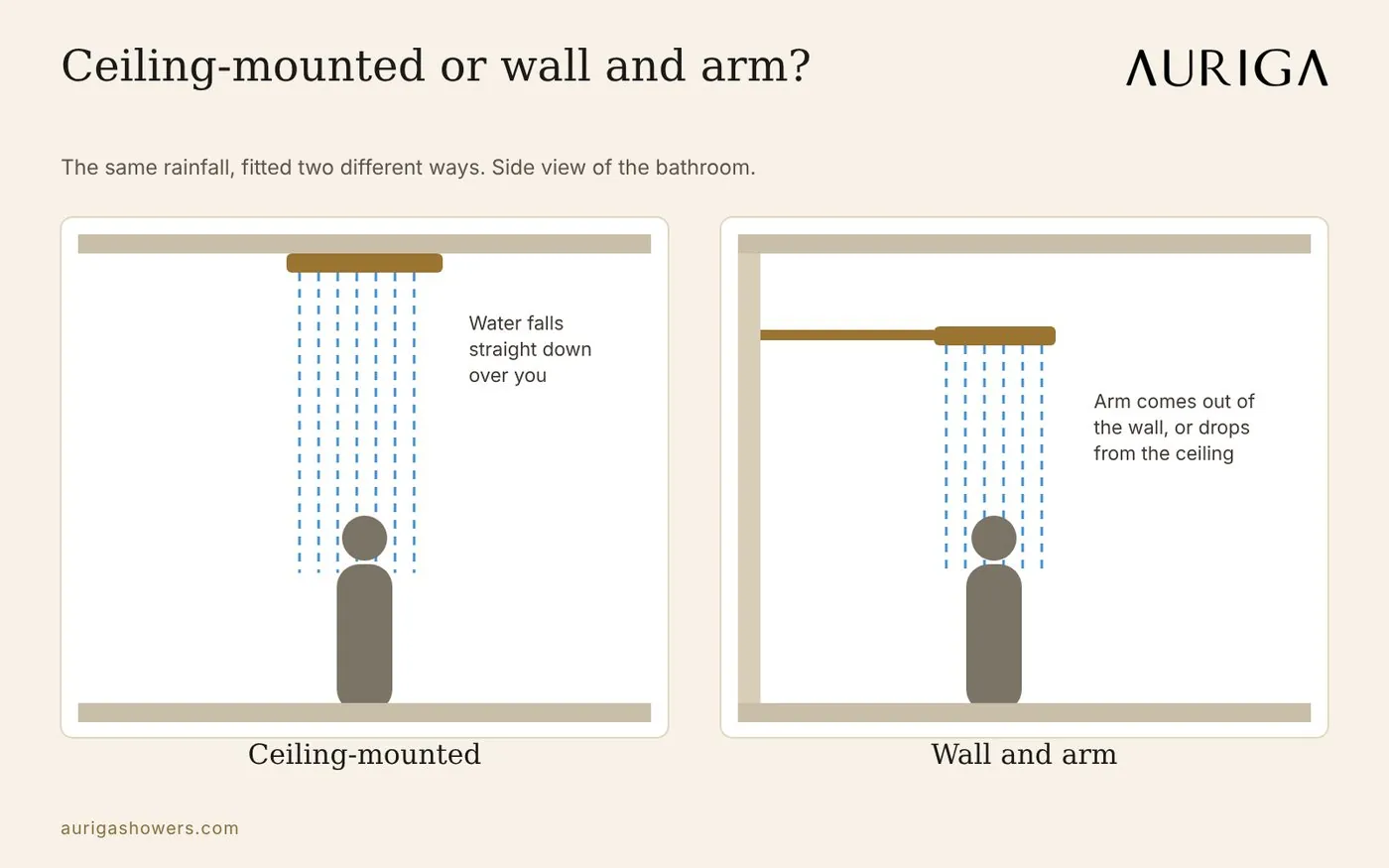
A ceiling-mounted rain shower sits flat on or in the ceiling, directly above you. Water falls straight down in a wide, even sheet. A wall-mounted shower is fitted on an arm that comes out of the wall, and the same arm can also drop down from the ceiling as a straight arm. The head hangs at the end of it, usually a little in front of you.
How they compare
| Ceiling-mounted | Wall and arm mounted | |
|---|---|---|
| How the water falls | Straight down, centred over you | From the front or above, toward you |
| Look | Clean and minimal, nothing on the wall | Visible arm, can be a design feature |
| Fitting | Pipe goes into the ceiling | Pipe goes into the wall |
| Easiest in | New build or full renovation | Almost any bathroom, including renovations |
| Head height | Fixed by the ceiling | Set by the arm length and wall position |
| Sizes we make | 400 to 600 mm square and 500 mm round | From 80 mm to 600 mm in several shapes |
Choose a ceiling-mounted shower if...
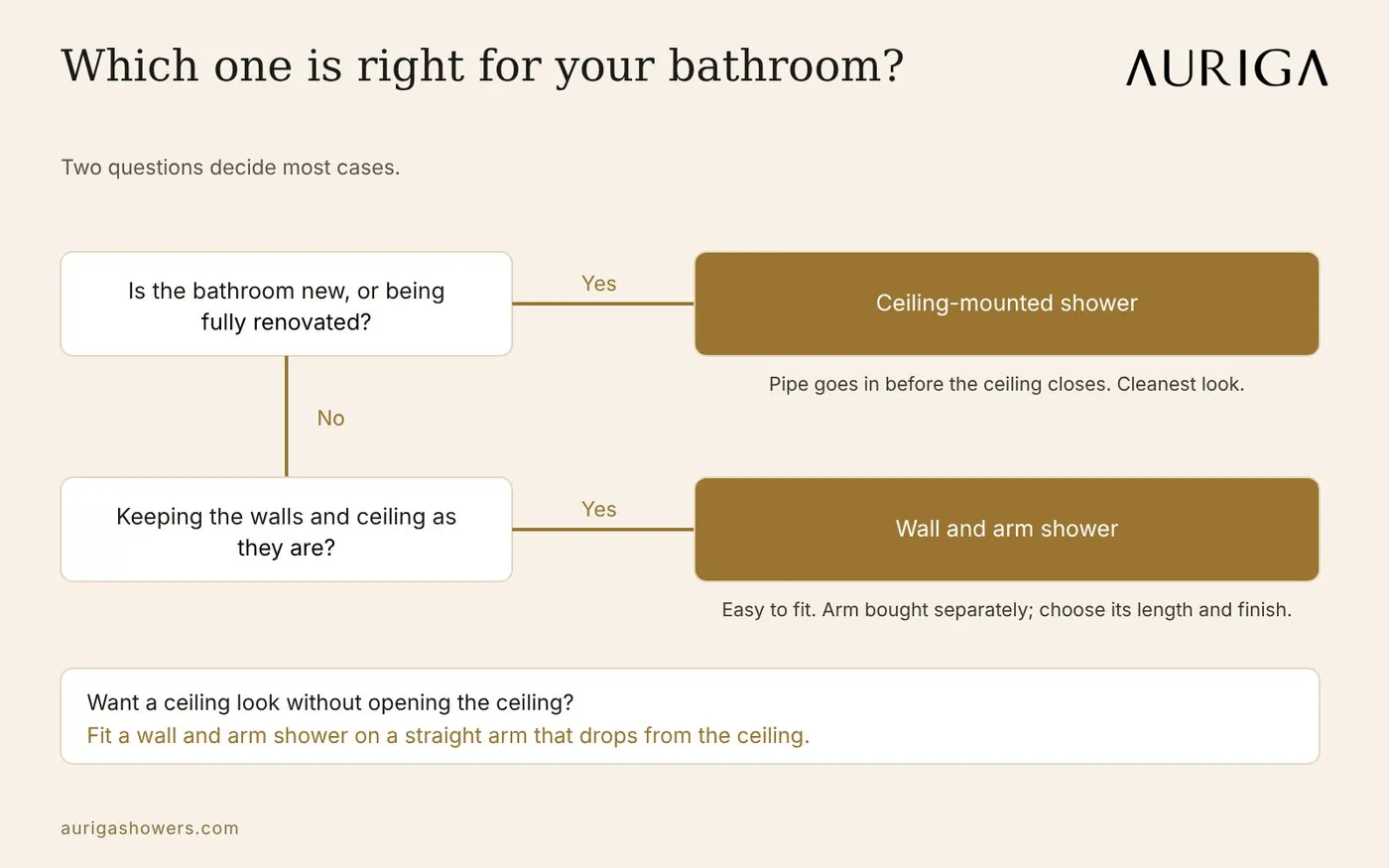
- You are building a new bathroom or renovating fully, so the ceiling and pipes are open anyway.
- You want the cleanest look, with no arm and no fittings on the wall.
- You want rain that falls straight over you, as in a walk-in shower.
- Your ceiling has room above it for the pipe and fitting. Our ceiling showers come with the necessary fittings and frame, so your plumber does not need to source parts.
Check the ceiling height first. A very low ceiling leaves little room for the fitting, and a very high one puts the head far above you, so ask your plumber to confirm the height.
Choose a wall and arm shower if...
- You are keeping the existing bathroom and do not want to open the ceiling.
- Your pipe already comes out of the wall at shower height, which is common in older bathrooms.
- You want to place the head where it suits the user, rather than directly overhead.
- You like the look of a longer arm, or you want a smaller or differently shaped head.
Our wall and arm showers can also be fitted on a straight arm that drops from the ceiling, which gives a ceiling feel without a recess. The arm is not supplied with the shower, so you buy it separately.
Two things that matter whichever you choose
- Water supply. A large head needs enough pressure and flow to keep every nozzle working. Read our guide to water pressure for rain showers before you choose a size.
- Who will fit it. Ceiling fitting is more involved and best planned before the false ceiling and tiles go up. Tell your plumber the model before work starts, so the pipe is in the right place.
Buying the shower arm (wall and arm showers)
Our wall and arm showers are supplied without the arm, so you choose and buy the arm separately. Three things help:
- Length. Choose it so the head sits over where you stand, not on the wall side. A longer arm moves the water further into the shower area.
- Style. A wall arm comes out of the wall; a straight ceiling arm drops from above and gives a ceiling look.
- Finish. Match the arm to the shower's finish, so the two look like one piece.
Tell your plumber the arm you have chosen before the pipe is placed, so the position is right the first time.
A simple way to decide
If the bathroom is new or fully renovated, and you like clean lines, choose a ceiling-mounted shower. If the bathroom is staying as it is, or you want to adjust where the water falls, choose a wall and arm shower. Most models in both styles come in SS Mirror, Gold, Rose Gold and Black PVD, so the choice is mainly about fitting, not looks.
Next steps
Browse ceiling overhead rain showers or wall and arm overhead rain showers. If you want mist, waterfall or intense modes as well as rain, see overhead multifunction showers. For help choosing, use the contact page.